Tool
Cut costs, fund growth, and embed sustained performance in your operating model.

Published
16 April 2026
Companies can no longer rely on temporary cost cuts to protect performance. To create lasting impact, cost discipline must be built into the operating model itself – embedded in strategy, processes, governance, and leadership.
When organisations re-design how work gets done and how decisions are made, cost reduction becomes more than a short-term exercise. It becomes a source of structural efficiency, greater resilience, and funding for future growth and transformation.
In a time of macroeconomic turbulence, many companies are being forced to rethink their cost base, increase transparency, and respond faster. The challenge is no longer just to cut costs – but to build a business that can stay cost-fit while continuing to adapt and invest.
Figure 1: Visualisation of CEO and CFO outlook.

Cost reduction that sticks is not a one-off event. It is a discipline that funds strategy while protecting performance. Implement’s cost-out by design approach links decisive cost measures to how your business actually runs, embedding cost performance into processes, decision rights, and leadership rhythms.
The result is 10-30% run‑rate savings and a 5-10% uplift in EBIT margin within 6-18 months, with a system that keeps your cost base competitive over time.
Today, organisations face a different cost equation from even just two short years ago. Demand patterns are uneven, capital is tighter, and AI is compressing the cost of knowledge work. Inaction is not neutral. The leadership choice is not whether to reduce costs, but how and to what end. The new playing field dynamics are producing distinct conditions that motivate cost-out.
Figure 2: A simple cost curve comparing “one-off cost-out”, which delivers a temporary dip followed by a rebound, with “cost-out by design”, which creates a step-change down and a flatter slope over time due to built-in cost avoidance.
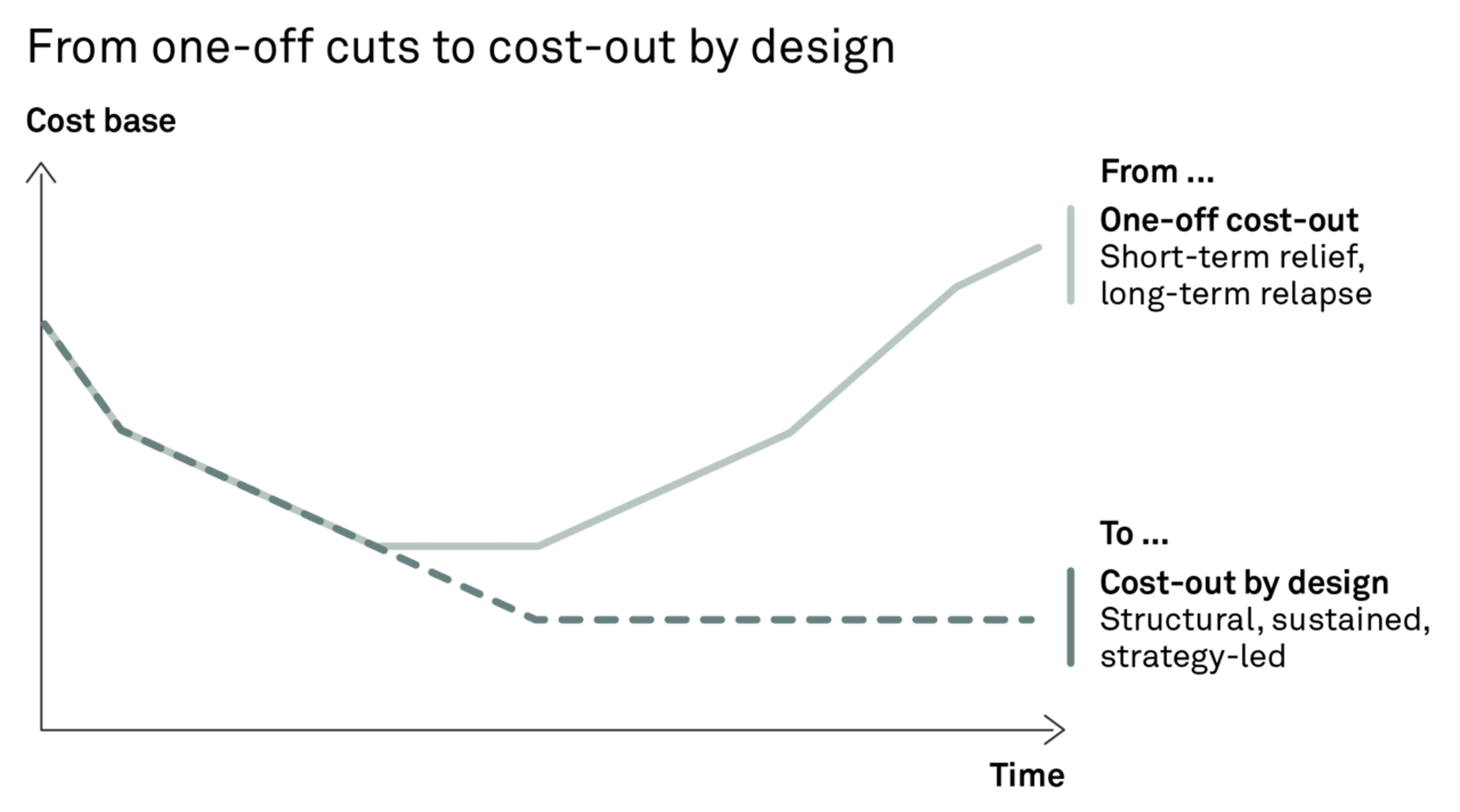
We see three effective paths:
- The lifeline: Stabilise fast when liquidity, demand, or investor pressure requires decisive action. Tighten the cost base with surgical efficiency and protect the core.
- The funded journey: Self-funding strategic bets. Release capital from SG&A and support functions to reinvest in growth and resilience.
- The AI-led bold move: Fundamentally re-design and scale operations through AI and automation, resetting how tasks, decisions, and service levels are delivered.
Each path demands different guardrails and different levers, but all require one thing in common: linking cost actions directly to the operating model so gains convert into run-rate performance and do not bounce back.
Typical pitfalls of cost-out programmes
Cost-out programmes often fail for reasons that are both common and avoidable. If seen as a standalone exercise, cost-out programmes introduce the risk of:
Our approach
Beating the industry cost curve requires turning cost discipline into the way the company runs, not a seasonal programme. That means re-designing how decisions are made, how work flows, and how leaders lead so cost avoidance is built in.
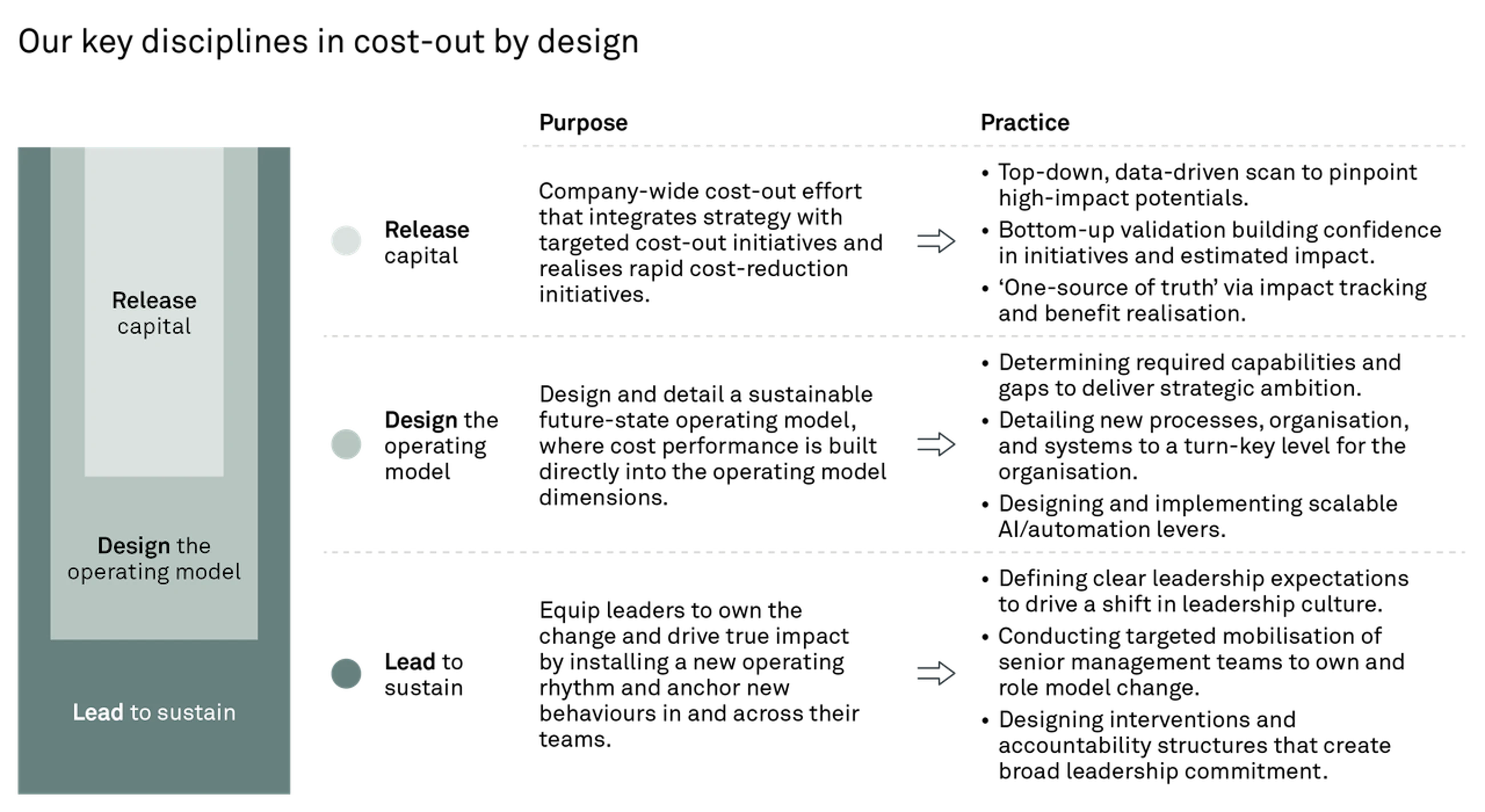
Implement’s cost-out by design approach integrates three disciplines to deliver rapid impact and lasting performance:
- Release capital (identify, prioritise, deliver)
Top-down scans pinpoint high-impact potentials; bottom-up validation builds conviction and pace. We track real P&L impact via a single source of truth and a disciplined benefit realisation cadence. - Design the operating model (lock in the gains)
We convert short-term savings into a new normal by re-designing structures, governance, processes, and digital enablers. We selectively embed AI and automation where they change the economics of work, shifting from people-dependent efforts to a system where performance is built in and scalable. - Lead to sustain (make it leader-led)
Leaders set ambition, remove constraints, and model the behaviours that make new ways of working stick. We equip executives and P&L owners with a practical operating rhythm: clear decisions, transparent tracking, and routines that reinforce productivity and accountability.
Figure 3: The cost-out by design disciplines
What impact looks like
Within 6-18 months, programmes typically deliver:
- 10-30% yearly run-rate savings on the applied cost base.
- 5-10% uplift in EBIT margin.
- Rapid, visible effects within 3-6 months and a strengthened operating model within 6-18 months.
Illustrative outcomes
Across industries, leader-led programmes have delivered double-digit-% run-rate savings, accelerated integration and simplification, reduced cost-to-serve, and improved speed and quality in critical processes. The common thread is execution discipline, clear ownership, and operating model re-design, not just a catalogue of initiatives.
Outcomes leaders communicated to the market:




Make cost a competitive capability
Sustained cost performance is not an event. When cost-out is strategy-led, designed into the operating model, and owned by leaders, organisations consistently beat the industry cost curve.
The near-term benefit is material P&L impact; the long-term prize is a repeatable capability that funds growth and builds resilience.
Interested? 12
We can help you take the next step
- Non-binding dialogue: 45 minutes with our senior experts to showcase our approach and pressure test your ambition
- Executive offsite (1 day): Align the 3-5-year ambition, choose where to play and how to win, and commit scope and governance for the sprint.
- Diagnostic sprint (3 weeks): A rapid scan to size cost and growth pockets, validate with your leaders and define risk guardrails.
Related0 4
Article
Read more

Designing leadership principles that work
A systemic approach to creating leadership principles that are anchored in organisational context and drive strategy exe...Article
Read more

Change fatigue: when constant adaptation becomes exhaustion
Why building change resilience is now a leadership disciplineArticle
Read more

Are you about to pay twice for inflation?
The last crisis may never have left your P&L. This one is compounding on top of it.Article
Read more
