Article
Repositioning focus from lifespan to healthspan and wealthspan

Published
6 March 2026
The article is co-authored by Nadine Esposito, CEO and founder of Wellthspan Advisory.
As longevity has risen, a mere focus on lifespan is no longer enough to age sustainably. We need to reposition our focus to healthspan as well as wealthspan to shape the extra years as opportunity instead of strain. Using a simple 5+1 framework from Wellthspan Advisory to keep the whole life in focus, we can make small moves today to make longer lives work significantly better for families, employees, and customers.
We are quietly moving into a world of 90- and 100-year lives, while most of the systems that carry us through adulthood were built for lives that ended twenty to thirty years earlier. Counting years lived is no longer enough; what matters is how long people remain healthy and financially in control, and how long they can rely on the systems around them without becoming a burden on themselves or others.
For households, employers, and financial institutions, the real ‘longevity challenge’ is to maximise the years we spend in good health and financial security while shrinking the period of dependency and strain at the end of life.
A life you might recognise
She is in her mid-forties. She enjoys her work, exercises regularly, and is careful with money. Her grandmother hoped to see seventy. Her mother reached her late seventies and now needs help with everyday life. She herself may well live into her nineties.
When she looks ahead, she does not see a straight line. Career programmes around her still assume a peak in the early fifties and a smooth glide into retirement. Pension rules and products are calibrated for short drawdowns, not three or four decades of post-work life. Health insurance pays generously for treatment but offers much less for prevention, mental health, or sustained resilience. Financial advice tends to project today’s household into the future as if it will stay stable, although she knows that careers, relationships, health, and responsibilities will change. Her family is spread across cities. The house she loves may one day be difficult to navigate.
She has not failed. The systems around her were designed for the lives her parents lived, not for the life she is likely to live.
How we gained years – and why they feel fragile
The extra decades were not won by miracle anti-ageing drugs. They came from basic progress: clean water and sanitation, vaccines and antibiotics, safer roads and workplaces, better care for mothers and infants. People now survive childhood and midlife and reach older ages in far greater numbers. This ageing success is real. But the redesign of the system to handle ageing sustainably has not kept up.
As longevity increased, it has become clear that measuring only the number of years lived is insufficient to describe lived reality. Two people may live to the same age yet experience those lived years in profoundly different ways.
This recognition has led to two additional concepts, beyond lifespan, that approach ageing more holistically:
Healthspan measures the years lived in good physical, mental, and cognitive health – the years in which people can live independently, work if they want to, make decisions, and enjoy relationships.
Wealthspan measures the years in which financial resources translate into genuine choice: when there is enough income and liquidity at the right time, and enough cognitive capacity and support to manage complexity.
A long life without health or financial agency does not feel like success; it is an extended period of exposure to risk and dependency.
Six everyday gaps in longer lives
Longer lives and older systems create tension which shows up in ordinary decisions rather than in abstract debates.
Six gaps are particularly visible:
Medicine built for cure, not prevention. Health systems excel at acute care, yet the conditions that shape later life – chronic disease, mental health challenges, cognitive decline – unfold over years. Prevention and early detection pay off, but incentives still favour treatment once something has gone wrong, and few people have protected time for health.
Wealth planning for short retirements, not uneven complexity. Traditional plans imagine continuous careers and a brief drawdown. Real lives are more uneven: careers shift, caregiving interrupts earnings, health events arrive unexpectedly, and retirements can last for decades. Wealthspan depends on income timing, liquidity, and resilience – and on the ability to make good decisions as life becomes more complex.
Work organised for continuity, not reskilling. A degree at twenty will not carry someone through fifty or sixty working years. Skills expire, new roles emerge, and phases of recovery or caregiving create gaps. Many career ladders and pension rules still penalise interruption, even though longer lives require explicit paths for reskilling and more flexible ways of working.
Family care assuming proximity, not fragmentation. Care systems still rely heavily on families to provide coordination, supervision, and everyday support. Yet families are smaller, more geographically dispersed, and often stretched by work and childcare of their own. Many people live alone for long stretches of adulthood, while caregiving responsibilities arrive later, last longer, and are harder to combine with paid work. When care needs increase, support is often fragmented and uneven, shaped more by who happens to be nearby than by what is actually needed.
Housing designed for shorter occupancy, not prolonged living. Most homes were not built for changed mobility or cognition. Stairs become barriers, bathrooms turn into risk zones, and isolation grows when driving is no longer safe and neighbours move away. Moving late in life is difficult and often happens in a rush after a health event, yet housing is also the main store of wealth for many families. That creates a constant trade-off between place, safety, and liquidity.
Care risk: the gap between planning and availability. Most longevity planning assumes that if care is financially secured, it will be accessible when needed. But care risk challenges that assumption. With growing demand and persistent care workforce shortages, having the means to pay for care no longer automatically guarantees access to it. A person may have planned carefully, set aside the funds, even identified providers in advance – and still find that when care is needed, capacity simply is not there. Care risk is not primarily a financial failure. It is a supply and coordination failure that no amount of financial planning can fully hedge against.
Over longer lives, these gaps compound. A health issue at fifty influences earnings at fifty-five, savings at sixty, care options at seventy, and housing decisions at eighty.
A simple way to see the whole life
Single fixes tend to disappoint because they ignore the wider picture. A simple way that households, employers, and financial institutions can hold this wider picture is to use the 5+1 framework, developed by Nadine Esposito, Founder of Wellthspan Advisory.
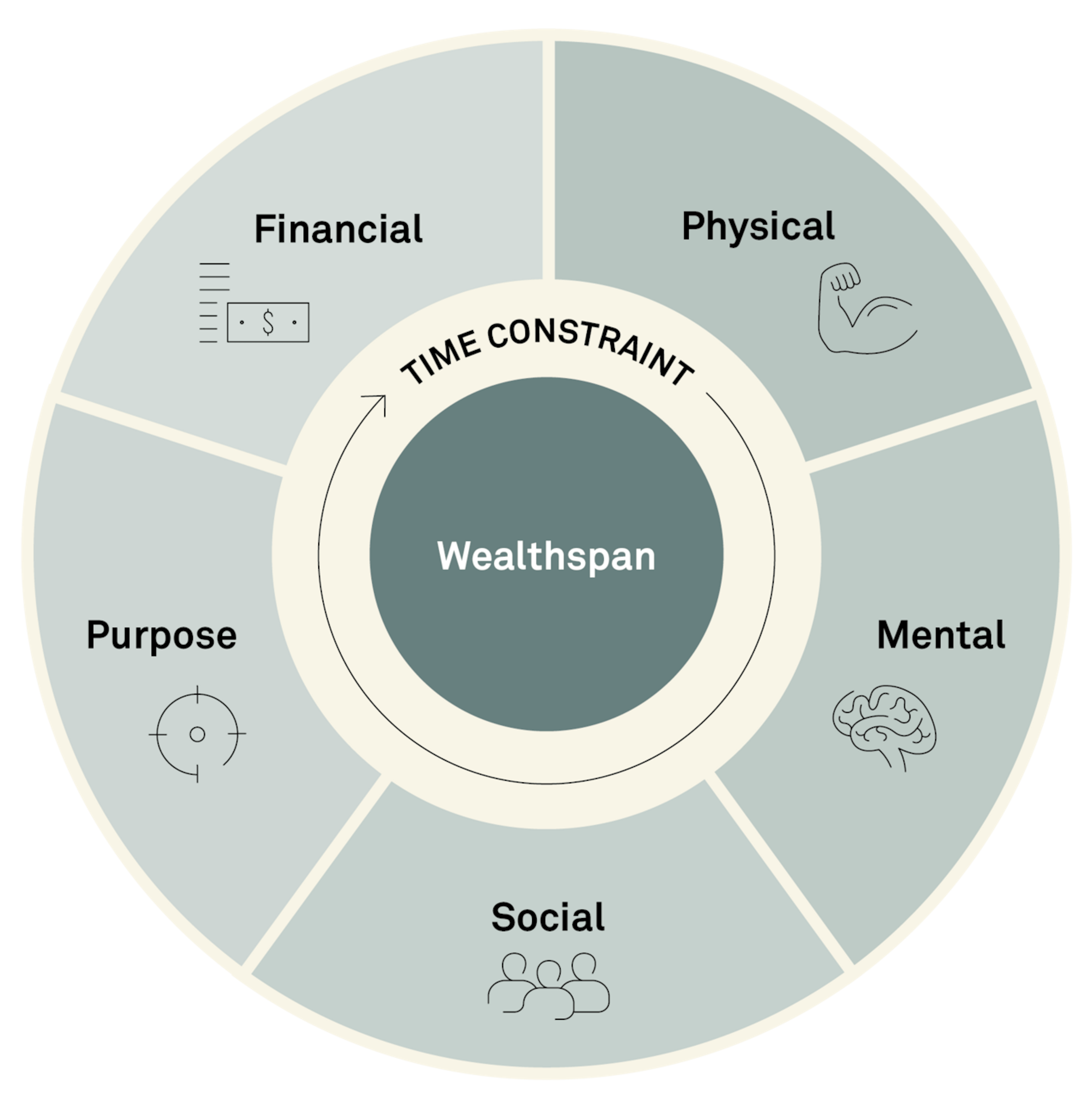
The framework organises wellbeing into five pillars – physical, mental, social, purpose, and financial – with time as the inevitable sixth element that binds them together.
- The physical pillar: This represents your long-term functional capacity. It prioritises preventative health and recovery to ensure that energy remains a reliable asset over decades, rather than a declining liability.
- The mental pillar: Focusing on cognitive longevity and emotional resilience, this pillar governs your ability to navigate increasing complexity and manage stress. It ensures that as life stretches, the capacity for sound decision-making remains intact.
- The social pillar: This is the infrastructure of your relationships and community. Robust social networks act as a critical safety net; conversely, isolation serves as a measurable risk factor for both health decline and poor financial choices.
- The purpose pillar: Meaning is the engine of a long life. Whether through professional work, creative pursuits, or caregiving, a clear sense of purpose maintains identity and motivation, preventing the ‘stagnation’ often associated with traditional retirement.
- The financial pillar: Beyond simple investment returns, this pillar focuses on structural resilience. It emphasises liquidity, the timing of cash flows, and the decision support systems needed to protect resources across a 40-year post-work horizon.
- Time: the universal constraint. Everyone has the same twenty-four hours. How those hours are allocated decides which pillars are strengthened and which are slowly eroded.
These pillars constantly interact. Health affects work and wealth. Housing shapes social ties and safety. Caregiving shapes careers and savings. Strength in one pillar can reinforce others, while weakness in one can pull several down at once. The longer the life, the more these effects compound.
Two longevity economies at once
The increased longevity does not affect all generations in the same way. This gives rise to two related but distinct realities within the broader longevity economy.
The silver economy describes the systems, services, and adaptations required for people already in or approaching later life. Those people made key choices when shorter retirements were the norm. For them, the task is mitigation: adapting housing, securing care, protecting agency and dignity as capacities shift, and ensuring financial arrangements support these goals.
The lifetime economy covers younger cohorts such as Gen Z and Gen Alpha – today’s ‘longevity natives’ – who will likely live much longer lives. For them, the challenge is design rather than retrofitting:
- Health becomes a long-term investment, not a late-life repair project.
- Education becomes continuous, not a one-off phase at the start of adulthood.
- Careers become flexible and multi-phased rather than a single ladder.
- Planning becomes dynamic, revisited at each major transition rather than fixed at a notional retirement age.
Public debate and resources often focus on the urgent needs of the silver economy; and that will remain important. However, the greater opportunity lies in building the lifetime economy so that each generation is better prepared instead of facing the same crunch in slightly different form.
Why this matters – a Swiss case study
Switzerland is already living this future. Life expectancy is high, and a large share of household wealth sits in property and pensions. The Swiss three-pillar pension system is robust and tightly regulated, which makes the longevity conversation concrete rather than theoretical.
Some conversations we must have to move towards sustainable ageing:
Mortgages and housing: Our current rules for affordability and amortisation were built for linear careers that end at 65, yet today’s reality involves non-linear paths and much longer working lives. We need financial designs that respect prudence while supporting independence at home through flexible financing and physical adaptation.
Pensions and decumulation: The first and second pillars were designed for a different era; today, the third pillar is no longer ‘extra’ but essential for maintaining a standard of living that might need to last up to 40 years past retirement. This shift requires a new kind of advice that prioritises liquidity and simple governance alongside investment returns.
Customer fairness and vulnerability: A longer life should not lead to blunt risk filters that shut people out. Instead, we must build processes that recognise changing needs, invite consent-based support, and proactively reduce friction to protect a client's dignity.
Banks' core opportunity. From a banking perspective, the challenge is to move beyond simply asking if the capital will last. The real question is how long a client will retain true agency over their choices – and how we protect that agency as health, cognition, or family structures shift. This opens a vital new conversation about liquidity design, protection against long-term care risks, and products that value the unpaid care work that sustains our society.
Toward a new playbook for 100-year lives
The longevity shift cuts across every domain: medical, social, economic, and financial. It reveals how strongly health, wealth, purpose, relationships, and time are intertwined, and how fragile our current arrangements become when lives stretch far beyond the assumptions on which they were built.
For financial institutions, this is not a niche marketing angle aimed at ‘silver’ customers; it is the next operating system of the business. Clients will increasingly expect advice and products that are designed for healthspan and wealthspan, that acknowledge the reality of sickspan and care risk, and that support not only individuals but the family systems around them.
The core questions are straightforward, even if the answers are complex. Are we still optimising for lifespan and short retirements, or are we ready to help clients structure lives – and the economic life paths – that can carry them through 80 years of adulthood? Do we treat prevention, care work, and cognitive decline as marginal topics, or as central components of financial resilience? Are we prepared to design for 100-year horizons, or will we continue prolonging the game without changing the rules?
For many people, living longer is now the default. Whether those extra years are lived with health, independence, and financial agency is the real choice ahead – for individuals, for families, and for the institutions that serve them.
In same series0 2

Article
Read more

Designing for 100-year balance sheets
What banks can, cannot, and should not do when health enters the balance sheet.Written in cooperation with

Nadine Esposito
CEO and Founder of Wellthspan AdvisoryWith over a decade of experience in risk management and a deep personal journey into health strategy, Nadine Esposito has seen first-hand how longevity is reshaping every aspect of our lives - yet few people, companies, or systems are prepared.
At the intersection of aging, financial systems, and health science, she has developed a science-informed, demography-driven framework for planning the decades ahead.
Nadine Esposito's 5+1 Longevity Pillars - physical, mental, social, financial health, purpose, and time - provide a blueprint for individuals and institutions navigating a 100-year life.
E: nadine.esposito@wellthspanadvisory.com
T: +41 797431136
Related0 4
Article
Read more
Designing for 100-year balance sheets
What banks can, cannot, and should not do when health enters the balance sheet.Article
Read more

Is your operations leadership fit for the future?
For operations leaders, the hardest question right now is about organisation design and the ability to change.Article
Read more